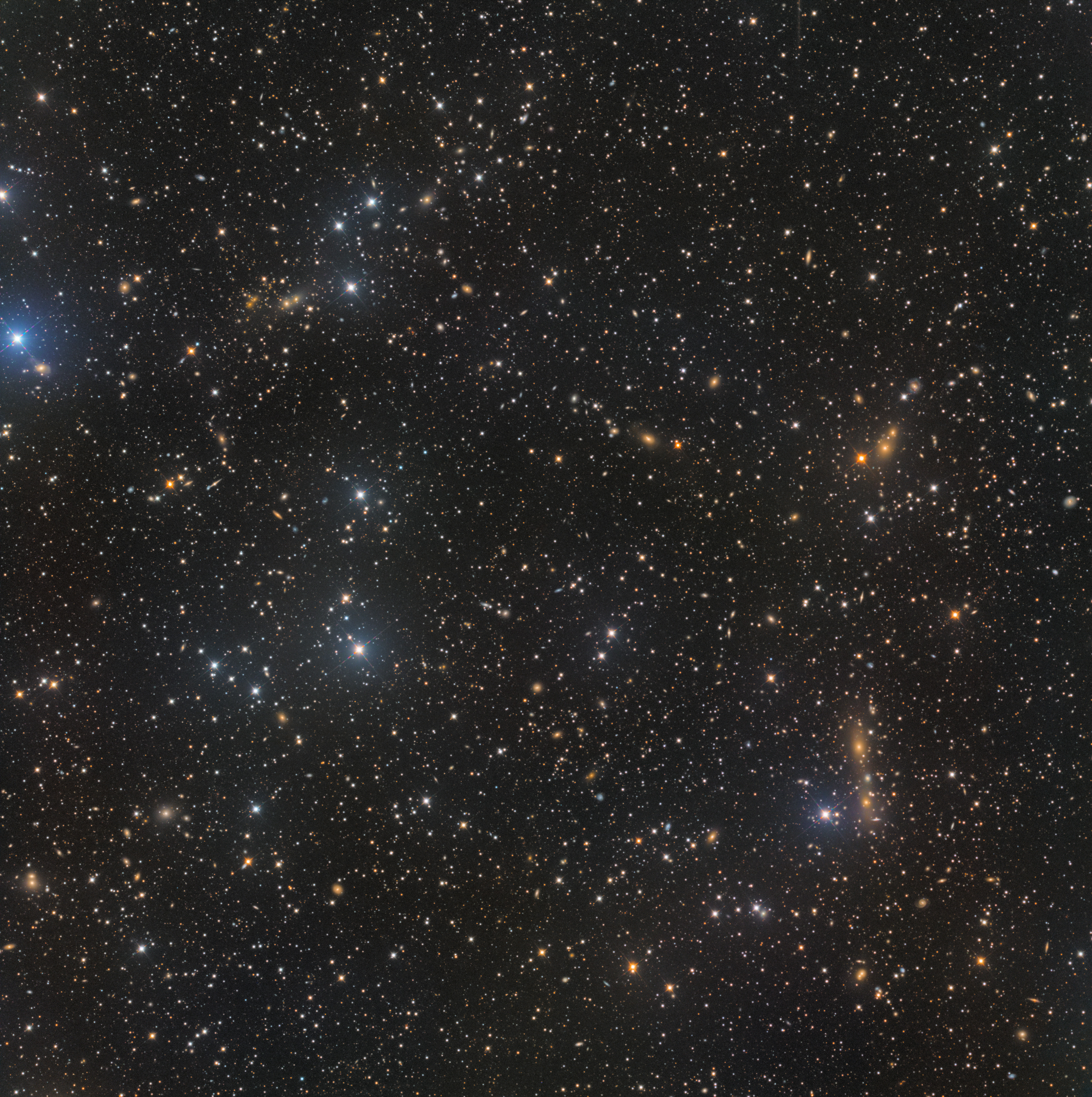
Abell 2152 et Abell 2147 en Lrgb
Commentaires sur l’objet photographié
2 amas de galaxies Abell 2152 et Abell 2147 distant de 550 millions d’années lumière et de 486 millions d’années lumière
Une vue annotate toujours intéressante à analyser.
Données techniques
Données techniques de prise de vue
Object :Abell 2152
Date : 19 mai au 20 juin 2026
Optics :SV400 Newton F3,8
Mount : Paramount ME Numéro 1
Location : Orange observatory
Seeing :
Ccd : Moravian G4 16803
filter wheel :Moravian
filters : Astrodon LRVB
Focuser :FLI Atlas
Guiding : SkyMeca DO et Atik 314L+
Temp. out :
Temp ccd :
Total exposure : 18.8 h
Luminance 59 x 10 mn
R 36 x 5 mn bining 1×1
V 36 x 5 mn bining 1×1
B 36 x 5 mn bining 1×1
Données scientifiques
Voici en lien une image avec les galaxies dans l’image.
Source Wikipedia
En bas à droite :
Abell 2147 is a galaxy cluster in the Abell catalogue.[3] It is located within the core of the Hercules Superclusters (SCI 160), within Serpens Caput, near the cluster Abell 2152, approximately two degrees south southwest of the Hercules Cluster (Abell 2151). It is possible that Abell 2147 is actually part of the Hercules Cluster considering that it shares the same redshift of 550 million light years.[4][5]
This galaxy cluster contains mostly faint, small and scattered galaxies.[4]
En haut gauche
Abell 2152 is a bimodal[3] galaxy cluster and one of three clusters comprising the Hercules Supercluster. It contains 3 BCGs; the S0 lenticular UGC 10204, the pair UGC 10187, and the SA0 unbarred lenticular CGCG 108-083.[2] In total there are 41 galaxies which are confirmed to be members of the cluster.[1] The cluster is classified as a Bautz-Morgan type III and Rood-Sastry class F cluster, indicating morphological irregularity and perhaps dynamical youth.[4] It is receding from the Milky Way galaxy with a velocity of 12385 km/s.[2]
Abell 2152 is the nearest cluster in which significant gravitational lensing of a background source has been observed. The arc-like background galaxy, known as J160529.52+162633.9, lies at a redshift z=0.1423 and has been magnified by a factor ~1.9 due to the lensing effect.[5]